



If hearing about personalization from the left and the right brought you here, strap in. You’ll be hearing about it much, much more. According to McKinsey’s report, personalized experience is set to become the cornerstone of marketing success within the next five years. Ignoring personalized marketing is no longer an option; it must become a top priority.
Part of our Email Segmentation Guide.
Yet, it comes with its challenges. Today, most personalization efforts hinge on cookies and third-party customer data. Given the escalating concerns surrounding data privacy, the future of marketing personalization is uncertain.
However, not to get too ahead of ourselves, there are still many ways businesses can provide personal experiences. But first, let’s see how implementing personalization can benefit your business.
Personalization Statistics at a Glance
- 71% of consumers feel frustrated when their shopping experience is impersonal;
- Personalization can increase revenue by 5–15% and improve marketing ROI by 10–30%;
- 75% of customers are more likely to buy from brands that deliver personalized experiences;
- 90% of marketers say audience segmentation improves email marketing performance;
- Brands delivering strong personalization see up to 45% higher conversion rates and 50% higher engagement;
- 92% of businesses are using AI-driven personalization to drive growth;
- Companies with strong omnichannel personalization strategies retain up to 89% of customers.
Benefits of Personalization
To personalize or not to personalize… actually, there’s no question, as with personalized and segmented campaigns, you can expect:
Improved customer engagement and loyalty
By tailoring your interactions with customers based on their preferences — see repeat customer strategies — see repeat customer strategies and behavioral data, you can make them feel like valued individuals. This personalized approach fosters stronger customer relationships and, naturally, improves customer retention.
Increased conversion rates and sales
When you deliver personalized messaging and offers that speak directly to your customers’ needs, you’re more likely to grab their attention and inspire them to act. This translates to more conversions and increased sales over time.
Improved brand perception and customer experience
Personalization shows your customers that you’re listening and care about their needs. Delivering personalized experiences consistently across channels creates a positive impression that strengthens customer loyalty to your brand. This enhanced customer experience sets you apart from competitors and keeps customers coming back for more.
Key Personalization Statistics
Here are 75+ marketing statistics to fill your hungry marketer brains with:
Top Personalization Statistics
- 71% of consumers feel frustrated when a shopping experience is impersonal.*
- 89% of marketing decision-makers consider personalization essential for their business’s success over the next three years.*
- Personalization can lift revenues by 5% to 15% and increase marketing ROI by 10% to 30%.*
- Epsilon study found 80% of consumers were more likely to make a purchase when brands offered personalized experiences.*
- Email marketing personalization drives superior ROI, with personalized campaigns averaging up to $52 per spent compared to $19 for a generic one.*
Personalization Marketing Statistics
Now that the jaw-dropping statistics are out of the way let’s look at personalization marketing through some in-depth statistics:
- 78% of marketers say they need more personalized content than they’re currently able to produce.*
- 83% of marketers recognize the shift toward personalized, two-way messaging.*
- 80% of consumers prefer personalized experiences, but only 48% say brands are delivering them well (while 92% of retailers think they are).*
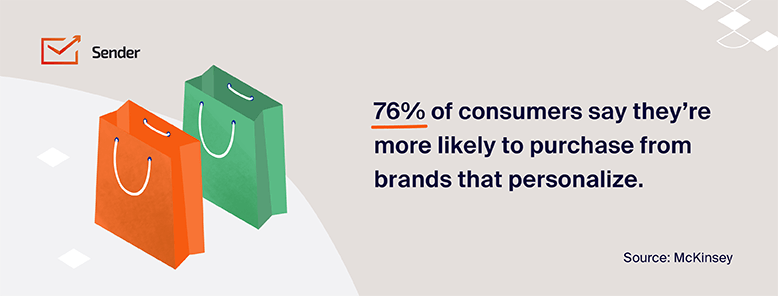
- 75% of customers say they’re more likely to buy from brands that deliver personalized experiences.*
- 71% of consumers want brands to anticipate their needs with personalized offers, but only 34% of brands can deliver this at scale.*
Email Personalization Statistics
Email personalization benefits customers and businesses: improved customer experience ensures the audience receives messaging and offerings tailored to their preferences. This leads to more engaged readers who are more likely to take action, resulting in a higher return on investment for businesses.
So, what are the most effective personalization tactics? As you’ll see from the statistics below, segmented campaigns and targeted messaging are key drivers of success:
- Marketers report a 10-15% increase in email revenue from adopting personalized and segmented campaigns.*
- Email subject lines perform better when they use personalization. They increase open rates by 10-14% across industries.*
- 90% of email marketing professionals report that using audience segmentation to deliver targeted messages increases performance for marketing emails.*
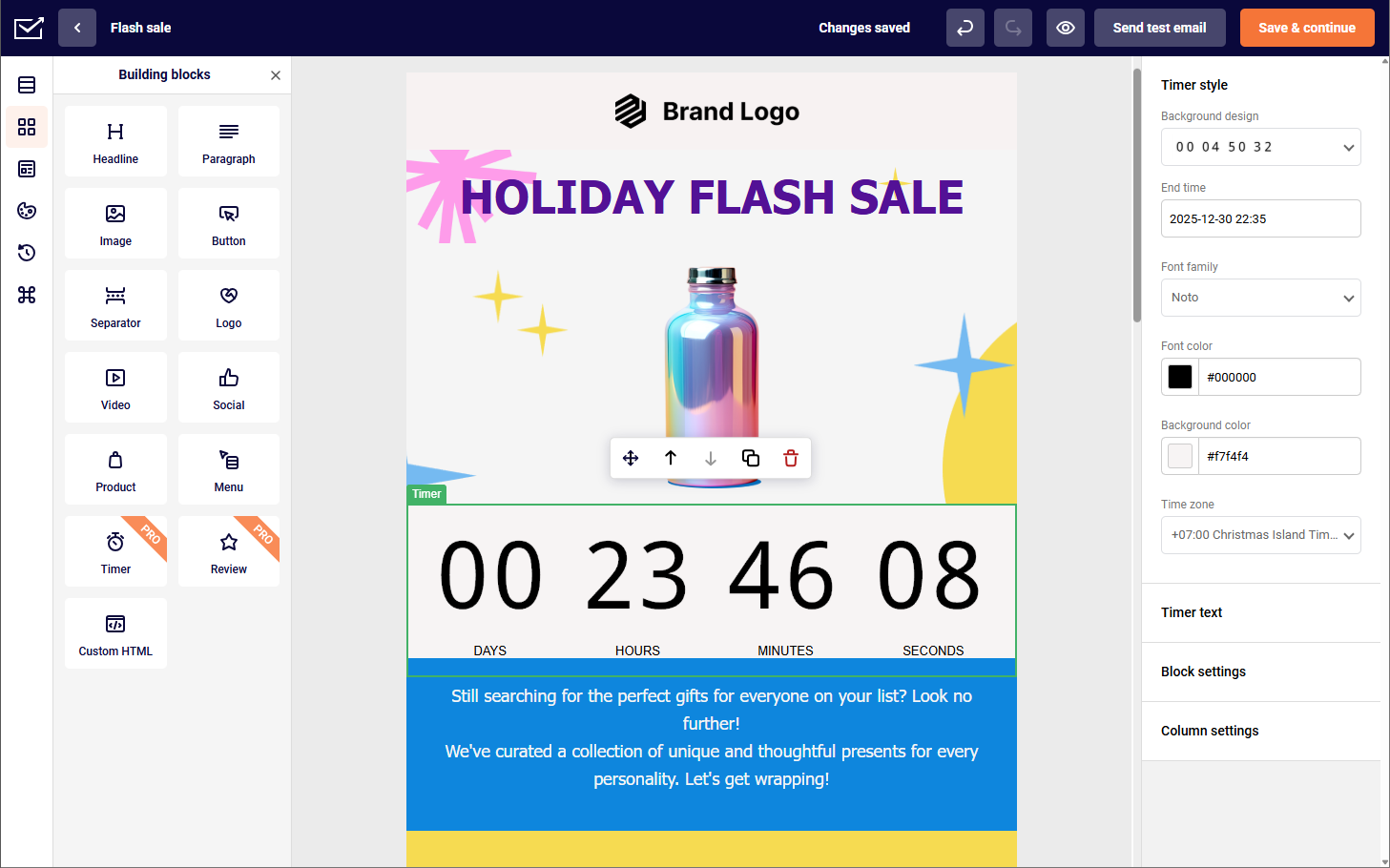
Personalizing your email campaigns couldn’t be easier with Sender. Reach your target audience effortlessly with smart segmentation in just a few clicks!
Find more shocking numbers on email marketing in the article about latest email marketing statistics and ROI figures.
Behavioral Personalization Statistics
Ok, we’ve looked through statistics to see what personalization can bring for you. But how does it actually influence your customers’ and prospects’ behavior? There’s more than one good personalization report revealing it:
- 64% expect tailored engagement based on past interactions.*
- 71% want brands to anticipate their needs but only 34% of brands deliver.*
- 75% are more likely to buy when brands personalize using relevant behavioral signals.*
Personalization Maturity Statistics
Many brands already have a personalization strategy in place. Unfortunately, the expectations don’t always meet reality. Personalization data reveals some interesting (and slightly concerning) insights:
- 78% of marketers say they need more personalized content than they can currently produce.*
- Brands are gradually advancing their personalization efforts, with 54% now investing in business, technical, and creative talent—an increase of 4% compared to 2025.*
- 62% of respondents still lack a unified audience strategy, though this marks a 5% improvement from the previous year, signaling gradual progress.*
Website Personalization Statistics
Ever noticed how websites seem to cater to your preferences? That’s website personalization at work. Instead of a one-size-fits-all approach, companies customize your online experience based on your interests and needs. Why? Well, it can increase your business revenue by 10-15%.
If that came as a surprise, wait until you get to know other statistics about website personalization:
- Up to 74% of ecommerce companies have a website personalization program.*
- 59% of shoppers say personalization makes it easier to find products.*
- Personalized landing pages can improve conversion rates by 25-40% compared to generic ones.*
Digital Advertising Personalization Statistics
People notice only what interests them. And sometimes it’s ads. But what can make an ad truly catch attention? You must be rolling your eyes if you went this far in the article. Of course, it’s personalization.
Digital advertising personalization efforts are all about using your information about your customers to create a more personalized shopping experience. One of the most common manifestations of this is ads powered by recommendation engines, delivering product suggestions tailored to each user.
For example, if a marketer catches that you’re in for some running shoes, you might get targeted with online ads everywhere you go. Because it works well. At least, according to the statistics:
- 56% of organizations say delivering more personalized customer experiences is a top AI investment priority.*
- 76% of customers said personalized messages were essential in enhancing their consideration of a brand, and 78% said such communication made them more willing to repurchase.
- 37% of shoppers buy more often due to personalized product recommendations (53% of Gen Z).*
Content Personalization Statistics
Content personalization involves using data to create dynamic content tailored for specific audiences or individuals on web pages and email. 71% of customers expect companies to deliver personalized content, so not adhering to their wishes can leave much on the table. Think engagement, revenue, and, indeed, brand loyalty. Let’s look closer at this claim:
- 21% of consumers expect more personalized experiences as a loyalty incentive.*
- 34% of shoppers say they find value in sharing zero-party data through quizzes, questionnaires, and similar tools in exchange for a personalized experience.*
- Retailers are also prioritizing advanced customer segmentation (43%), real-time data processing (43%), and predictive modeling to anticipate consumer behavior (42%) in 2025.*
AI and Personalization Statistics
Artificial intelligence has revolutionized personalization in 2025, enabling marketers to deliver individualized experiences at an unprecedented scale. These AI-driven personalization statistics reveal the massive impact this technology is having on marketing effectiveness and revenue growth:
- 92% of businesses are leveraging AI-driven personalization to drive growth.*
- Top-performing brands are 30% more likely to use AI-powered predictive analytics (e.g., churn prediction) to personalize.*
- 95% of consumers are interested in using at least one RCS-powered feature with brands.*
Personalization ROI and Conversion Statistics
We’ve talked about customer engagement rates, customer satisfaction, and experience, but what about top personalization statistics that show a measurable lift in revenue? It calls for a deeper look:
- 87% of organizations leveraging AI-driven personalization report higher customer engagement, highlighting its direct impact on marketing performance.*
- Brands that deliver strong personalized experiences see up to 45% higher conversion rates, 50% higher engagement, and 45% greater customer lifetime value compared to their competitors.*
- Customers with a high preference for personalization are willing to spend around 30% more with brands that deliver relevant, tailored experiences.*
Personalization and Customer Loyalty Statistics
If you were asked for 10 companies that do customer loyalty right, Amazon would probably be somewhere in there. It’s a company that has been rocking personalization, namely personalized discounts and recommendations, for over 2 decades now and has kept growing all those years.
“If we want to have 20 million customers, then we want to have 20 million ‘stores.’… Our mission is to be the earth’s most customer-centric company.”
Amazon founder Jeff Bezos
In statistics language, it would translate as:
- 53% of consumers say it’s worth sharing personal information if it makes their experience with a brand smoother.*
- 93% of consumers say a brand will lose their trust if it mishandles their data.*
- 62% of Gen Z and 64% of millennials would opt into hyper-personalized loyalty settings to access better perks and rewards.*
Customer Expectations for Personalization
Customer expectations for personalization are rising fast as consumers grow used to tailored, relevant experiences across every interaction. Today’s customers don’t just appreciate personalization—they expect brands to understand their needs, preferences, and behavior in real time.
The following statistics highlight just how high those expectations have become and where many brands are still falling short.
- 73% of customers expect better personalization as technology advances.*
- 61% of customers say most companies treat them like a number.*
- 80% of consumers prefer personalized experiences, but only 48% think brands deliver them well (while 92% of retailers believe they do).*
- 75% of customers are more likely to buy from brands that deliver personalized experiences.*
- 71% of consumers want personalized offers, but only 34% of brands can deliver them at scale.*
Personalization and Data Privacy Statistics
Personalization raises important concerns about safeguarding people’s data. When companies collect data to customize experiences, they must handle it carefully.
However, striking a balance between offering personalized experiences and respecting privacy isn’t easy. So, let’s delve into some intriguing statistics to better understand this delicate balancing act:
- Roughly 70% to 79% of Americans feel the risks to their personal data from company collection outweigh the benefits.*
- 87% of respondents stated they wouldn’t do business with an organization if they were concerned about its security policies.*
- 81% of consumers believe that the way a company treats their personal data reflects how the company views them as a customer.*
Mobile Personalization Statistics
Given that there are 5.78 billion mobile users worldwide and the number is expected to grow, mobile personalization should be at the top of your personalization list. After all, personalization works only if it’s consistent.
These statistics will guide your way:
- 76% of consumers shop on mobile devices because “it saves them time.”*
- Mobile commerce is expected to reach 62% of all ecommerce by 2027.*
Personalized Customer Experience Statistics
Consumers now expect completely personalized experiences when engaging with brands. You see them off to competitors’ doors if you don’t provide it. While it’s a nice gesture, it can break your business results irreparably.
These statistics paint a good picture of personalized customer experience:
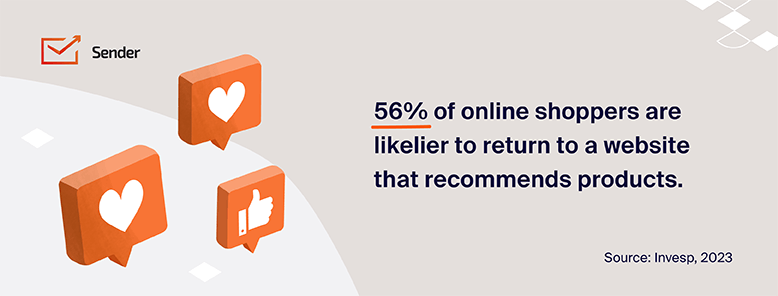
- 56% of consumers say they’ll become repeat customers after a personalized shopping experience.*
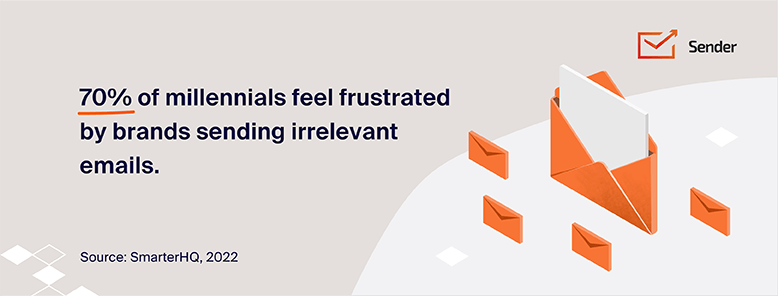
- 71% of consumers are frustrated by irrelevant messages.*
- 52% privacy-conscious consumers want control over their data.*
Omnichannel Personalization Statistics
Personalization isn’t a one-time thing. Nor is it a one-place thing. To create a truly personalized experience, a business must do it constantly throughout. It’s called omnichannel personalization, and these statistics prove that it’s here to stay despite some challenges:
- Companies with strong omnichannel strategies retain an average of 89% of their customers.*
- Only 35% of businesses offer truly omnichannel personalized experiences.*
- 73% of users engage across multiple channels during their buying journey.*
The Future Of Personalization
Personalization has evolved far beyond simply adding a first name to an email. In today’s fast-paced, AI-driven world – where people are constantly bombarded with ads and content – cutting through the noise requires delivering highly relevant, data-driven experiences that feel timely, useful, and tailored to each individual.
In the following sections, we’re going to review how real-time, first-party data and predictive personalization will shape the marketing landscape in the years to come.
Real-Time Personalization
Real-time personalization is becoming a key differentiator as customers expect brands to respond instantly with relevant content and offers. But there’s still a clear gap—80%* of consumers prefer personalized experiences, while only 48% feel brands are delivering them well, even though 92%* of retailers believe they are.
As expectations continue to rise, marketers are focusing on closing this gap by using real-time data to trigger more timely, context-aware interactions across channels—something we’ll explore further in the trends ahead.
First-Party Data Personalization
First-party data personalization is quickly becoming the backbone of modern marketing as third-party data disappears and privacy regulations tighten. More brands are turning to data they collect directly from their customers, with 61%* of high-growth companies already shifting toward first-party data for their personalization strategies.
As this shift accelerates, marketers are focusing on consent-driven data collection and using these insights to deliver more relevant, real-time personalization across channels—something we’ll explore further in the trends below.
Predictive Personalization
AI-driven personalization is quickly becoming a go-to strategy for brands looking to create more relevant, real-time experiences without extra manual work. And it’s paying off — as of 2025, 87%* of organizations using AI-driven hyper-personalization were already seeing higher customer engagement.
As more companies adopt it, the focus is shifting toward using AI to fine-tune timing, messaging, and channels—making personalization faster, smarter, and much easier to scale across the customer journey.
You like numbers? We do, too. Check out these stat articles, filled with valuable data:
- 40+ SMS Marketing Statistics You Should Know (2026)
- SMS Marketing Open Rate Statistics (2026)
- 40+ Latest Inbound Marketing Statistics (2025 Report)
- 40+ Landing Page Statistics with Industry Benchmarks
*Sources:
- https://www.smartinsights.com/ecommerce/web-personalisation/consumers-personalized-marketing-engagement/
- https://www.salesforce.com/resources/articles/customer-expectations/?sfdc-redirect=369
- https://www.mckinsey.com/capabilities/growth-marketing-and-sales/our-insights/the-value-of-getting-personalization-right-or-wrong-is-multiplying
- https://persuasion-nation.com/personalization-statistics/
- https://www.businessdit.com/personalization-statistics/
- https://www.statista.com/statistics/1208559/marketing-personalization-budget-share/
- https://www.hubspot.com/marketing-statistics
- https://www.statista.com/statistics/451788/digital-marketing-channels-with-personalized-communication/
- https://instapage.com/blog/personalization-statistics
- https://www.statista.com/statistics/451788/digital-marketing-channels-with-personalized-communication/
- https://www.marq.com/blog/content-marketing-statistics-will-make-you-think
- https://gopages.segment.com/rs/667-MPQ-382/images/State-of-personalization-report_reduced.pdf
- https://c.smarterhq.com/resources/Privacy-Personalization-Report.pdf
- https://www.statista.com/statistics/809137/leading-personalization-types-marketers-worldwide/
- https://www.statista.com/topics/4481/personalized-marketing/
- https://www.statista.com/statistics/1174164/investing-personalization-ecommerce-companies-worldwide/
- https://cdn.ciptex.com/website/State-of-Personalization-Report-Twilio-Segment-2023-1.pdf
- https://segment.com/pdfs/State-of-Personalization-Report-Twilio-Segment-2024.pdf
- https://www.businesswire.com/news/home/20250225215027/en/Braze-Global-Customer-Engagement-Review-Reveals-Key-Trends-for-2025-to-Help-Brands-Build-Stronger-Customer-Connections
- https://segment.com/state-of-personalization-report/
- https://www.contentful.com/blog/ecommerce-personalization-statistics/
- https://wisernotify.com/blog/omnichannel-stats/
- https://www.statista.com/chart/13139/estimated-worldwide-mobile-e-commerce-sales/
- https://www.salsify.com/blog/how-shoppers-feel-about-personalization-in-ecommerce
- https://business.adobe.com/resources/reports/customer-engagement-digital-trends.html
- https://www.deloitte.com/us/en/programs/chief-marketing-officer/articles/personalization-strategy-in-retail-media.html
- https://mailmend.io/blogs/email-personalization-statistics
- https://www.mckinsey.com/featured-insights/mckinsey-explainers/what-is-personalization
- https://www.epsilon.com/us/about-us/pressroom/new-epsilon-research-indicates-80-of-consumers-are-more-likely-to-make-a-purchase-when-brands-offer-personalized-experiences
- https://www.salesforce.com/news/stories/state-of-marketing-2026
- https://business.adobe.com/blog/how-to/personalization-at-scale-has-never-been-more-crucial-for-your-business
- https://www.salesforce.com/small-business/what-are-customer-expectations
- https://www.litmus.com/wp-content/uploads/pdf/The-2024-State-of-Email-Trends.pdf
- https://www.dynamicyield.com/personalization-maturity/
- https://www.demandsage.com/personalization-statistics
- https://www.optimonk.com/conversion-rate-optimization-for-landing-pages
- https://business.adobe.com/resources/digital-trends-report.html?
- https://www.deloittedigital.com/us/en/insights/perspective/personalization-customer-personas.html
- https://www.pwc.com/us/en/services/consulting/business-transformation/library/2025-customer-experience-survey.html